Saturday, October 26, 2013

Does Anyone Watch Cooking Shows for the Spatula? An ECOO Reflection

Another conference complete, and another set of thoughts swirling through my head! That's the feeling I now have after attending ECOO 13 - Bring IT, Together. Anyone who attended would attest to it being a great conference - well organized, very diverse set of sessions, excellent keynote presenters, and a wealth of information gained through many discussions. I always find myself walking away from professional development such as this, with a hundred new ideas to try, and a hundred more questions that need clarifying. Many of these thoughts and questions have been shared by many, as the twitter stream (#ecoo13) provides such confirmation. However, like last year, I thought I would share my 5 takeaways from the conference. Here they are, in no particular order of importance, significance, or any other ranking:
  1. Teachers Role in Educating Peers - I found myself in a number of conversations with other teachers who are attempting to teach other teachers edtech. The same questions always surfaced, with the big one being - "How?" How do we encourage other teachers to adopt educational technology, and integrate it effectively into their teaching practice? The answer to this question - No one knows! For a long time I have thought that this is unfortunate; however, I am beginning to find this encouraging. I don't believe there ever will be a definitive answer, nor do I believe there should be. As well, I think that it is a continuous process and we have to use a different set of tools to help & encourage our peers; and one way will not work with everyone. The simple fact that we are having this discussion is the encouraging sign. What it shows is that many teachers have realized that we have a place in supporting each other, and we can learn from each other along the way. In my mind, that is so much more profound than if we had found a single answer to apply to everyone.
  2. Students Need to be Creators & Collaborators, Not Just Consumers - I heard this mentioned in a number of sessions, and from both Amber Mac & Jamie Casap (keynote presenters). I love how this indicates just how much the conversation is changing with regards to the 21st century education. I have found the focus of many 21st education conversations to be about how to deliver information, access information, and a little bit about creating; using this cool new app, that cool new website, etc. However, 21st education has to be about more than consuming, and I loved how many people referred to this.
  3. Wifi is as Important as Electricity - Now don't get me wrong, this is really a statement of context, and depends on a whole range of things. However, when it comes to 21st century education and the way a classroom should function today, I think this is very true. As mentioned previously, we want our students to be collaborators, creators, curators, critical thinkers, and communicators, and to engage in these activities across borders and with others around the globe. In order to do this, we need to focus on ensuring that connection is reliable. I hope one day we do take wifi for granted, as we do currently with electricity. That will signal to me, that we have realized how important it is to communicate with others around the globe.
  4. Technology SUPPORTS Pedagogy and Content - I also love the fact that much of the discussion moved away from "Here's a new app" to "Here's a new app, and this is how it supports learning in my classroom". Any new app, website, or other piece of technology, is a tool just like the pencil, typewriter, or any other classroom tool we have used throughout history. Technology is just a tool, how it's used is what matters. There were great sessions and conversations around SAMR, TPACK, the 4/6 C's of 21st C skills, and what goes on in a truly 21st C classroom. When it comes to any educational technology trend, I think this is very important to remember. Whether it's blended learning, BYOD, or the flipped classroom, the focus and conversation has to be about the classroom - NOT the tech tool. I like to think of it this way - I don't watch the food network to see what spatula the chefs use. Who would? I watch to see the creation.
  5. The Value of Conversations - As great as the sessions were throughout the conference, I made sure to take a break each day so I could engage in both real conversations and those on Twitter. I find these conversations are where I learned some of the best things. I wish all PD realized the value of informal conversations, where teachers could come together and just share anything & everything (it's also probably why I think edcamps & unconferences are so great). 
There is a lot to think about now that the conference is finished. Lots to consider, lots to attempt to implement, and lots to further research. 

Monday, October 21, 2013

Technasium Roadshow

Well we've decided to take the #Technasium on the road - we've packed up the room, put the whole thing in a winnebago (pretty large winnebago I know!), and set out on the open road to share our idea. We have Steppenwolf blaring through our soundsystem, and nothing but freedom in front of us.  First stop is the ECOO & OASBO ICT Conference 2013 - "Bring IT, Together".


We have never presented our idea to anyone outside of our school before, and don't know how it will be received. We keep thinking it will be a very large room, filled with the sound of crickets - we just don't know what to expect?!  However, surprisingly we have begun to see some interest developing, as people have connected via email, Twitter, and other social means who wish to learn more. Some will be attending in person, others unfortunately, can not. Therefore, thought it might be beneficial to live stream our session, for those who are unable to attend. And with the support of Ustream we have created our own channel for the session - Enter the #Technasium


Live streaming video by Ustream


So if you can't make it, not to worry. Grab a comfy chair, a coffee, some popcorn, and watch it live on Thursday, October 24 @ 2 PM.

Friday, October 11, 2013

Lack of Trust? or Just a Misunderstanding?

How would you describe the phone you have in your pocket? Would you just call it a cell phone? Would you call it a computer? A gaming device? A glorified calendar? Address book? Organizer? Or a device that allows you to waste hours of your day? Whichever description best suits your device, one thing is apparent. It's not really the device that determines the description, but the user.

Thanks @gcouros for the inspiration!

Most of us possess an 'i' device of some sort, and are constantly checking it, playing with it, or using it for just about everything. When you think of it, it's actually quite amazing isn't it? We are able to connect with each other in so many ways now. To some this seems strange and foreign, and doesn't make sense. To others, this is just the way we do things now.

I was struck by this today during our professional development day. I am a constant Twitter'er and find the information and messages on it to be a great source for learning. As I was participating in my own professional development, I was on Twitter as well, learning from other teacher's in our board about what they were doing. I saw tweets from teachers and schools across the board sharing their own experiences, quotes, videos, thoughts, and just about everything else. If I were to attempt to find this information out another way, it would take me days to send out emails, phone calls, or carrier pigeons; and I still would never gather such interesting information.

I also take all my notes on my device. I find it very beneficial as I don't have to worry about carrying around another 'tool' to do so. I can organize them, tag them for future reference; and add not just text, but visuals, links, and anything else I feel would benefit my ideas. I'm able to organize and express my thoughts this way, without worry; and access them no matter where I am. To others this may look like texting or someone who is distracted, to those who use their device in the same way, it's just normal practice.

Our own students use their devices in much the same way. They own very powerful, portable computers and can use them to do just about anything. Many teachers would rather ban the devices from their classrooms, and tell their students to put them away while they learn. I always find this interesting, as such devices can (and should) actually aid their learning. Don't get me wrong, there is a time and place for them to be put away, and greater digital citizenship is needed by our students. During tests, while having group discussions, and a few other activities would all provide reason for students to put their devices away. However, this is quite different from banning them altogether or for a period of time. Many will say those who don't allow students to use their devices in the classroom, do not trust their students. I believe however, that it's not as much about a lack of trust, but a lack of information; and thus a misunderstanding about the ability students have with their devices.

My iPad and iPhone, have become my notebooks. Twitter has become my professional development tool and learning network. My PD is now controlled by me, where I am able to customize it to 'fit' me. I don't have to wait for learning, I go to learning. I follow interesting people, and share information from them on a regular basis. I have made a choice to learn from others, and not attempt to in isolation. I trust that others learn in the same way, and that students use their devices to engage and connect with others. It's their comfort zone - an environment where they are able to share, discuss, collaborate, and create. And isn't this what a classroom is all about?

Tuesday, October 8, 2013

Making Connections

The #Technasium is in full swing with lots of learning going on. Over the past month, the staff has gradually trickled in to learn about various edtech tools; with more coming each day. A few of us have even made it into our own staff room, and have been hanging out there each period we have off. It's provided an environment for collaboration, sharing, planning, and just about everything else we set out to accomplish. However, even if you plan, and plan, and plan, there are still some unforeseen events that may still occur. And that's exactly what we've seen with the #Technasium.

It all started with a very simple idea to encourage greater use of the room. We began a series of 'Lunch 'n Learns' where we have invited staff to come down to the #Technasium on their off-teaching periods to learn how to use devices such as document cameras; social media like Twitter; and other tools teachers have found very useful. An email was sent out, a tweet was tweeted, and next thing you know connections were made! We fully expected staff from the building to participate, but after a colleague sent out a tweet, it was amazing what happened next...


As a high school we have plenty of connections with the community around us. Jim realized however, that we also have plenty of connections with our feeder schools (or family of schools). Learning about edtech is not an isolated learning environment, but one where many people need to collaborate, share, explore, plan, and discuss. Whether you are a secondary teacher, or an elementary teacher, learning about effective instructional technology implementation is all the same. The simple tweet Jim sent established a connection where not only the intermediate school next door jumped on the opportunity, but also one of our elementary schools a number of kilometers away.


From this one tweet we've now seen teachers from outside of our school come into the #Technasium to learn about edtech tools with our own staff. It's an environment we could not have foreseen nor planned, but one that we have gladly welcomed. It's still in its infancy, and whether we see more teachers visit the #Technasium is still too early to tell. However, these connections that have established themselves may not have happened previously; and collaboration between a family of schools may not have happened otherwise. It's as simple as that. Provide an environment for teachers to learn, and the result will not just be learning, but connections as well.

Tuesday, September 3, 2013

Enter the #Technasium

"Meaningful change ain't gonna happen for our kids if we're not willing to invest in it for ourselves first. At the heart, it's not about schools... it's about us"
~Will Richardson

For obvious reasons, I don't believe there is a better way to introduce the Technasium, then to quote Will Richardson first. An educator who has continuously promoted & demonstrated the advancement of education technology in our classrooms, and its benefits for our students; it just seems like the right place to start. I was struck when I saw that quote because of its direct connection to a new initiative a group of us have started this year to hopefully improve educational/instructional technology adoption and use in our school. We have termed this initiative the Technasium, and believe it will provide educators an opportunity to 'just play'.


So what the heck is it?
Well it's really just a room like any other; a former classroom that was rarely used. However, it is now a classroom that houses a piece of every technology we offer at our school for staff to use (i.e. Smartboard, PC's, iPads, etc.)  It is open every period of every day, so that staff can come in and prepare lessons using the technology they have available to them. It provides an environment for staff where they can mess around with the technology without any judgement, pressure, or time constraints. There are no students around, and so the opportunity to learn outside of the typical classroom is now available to them every day. 

So why are we doing it?
Two of the main obstacles that we have found when it comes to the adoption of edtech into lessons are time and availability. Many teachers have said they just don't have the time to try out a new piece of software, hardware, or other piece of technology; and if they do, they just don't have a space to try it out in (availability). Many of us, myself included, don't feel like trying out a website for the first time in the class with the actual students - plenty of problems may arise, and there we are standing at the front of the classroom wondering what to do next?! Therefore, with the Technasium, staff are able to access any web 2.0 tool, software, or hardware (a simple printer even) so that they can begin to integrate technology into their lessons. Our true belief is that technology should not be a side project, but integrated into every lesson; and we hope one day this may become a reality.

How did we do it?
Well that's something I don't really have the answer to. It started as a simple idea, thrown around to a couple other staff, pitched to administration, and next thing we knew we had created it. It's amazing how simple dialogue can lead to big changes and innovation.


The idea of trying something new is daunting; investing a great amount of time, energy, and resources, is risky; and we have no idea what we are really doing?!  We don't know what the results will show, but we do know we are not going to wait for evolution to take place on its own. We believe the only way for such a change to happen is to make an investment on our own to really push the change.

Wednesday, August 21, 2013

Starting Fresh

The stores are abuzz with "back-to-school" sales; the CNE is alive with glowing lights, carnival toys, and food poisoning; and every teacher is counting down the number of patio/cottage/camping days they have remaining. Yes, it's that time of year again.


Epic Burger at the CNE (Epic illness?)

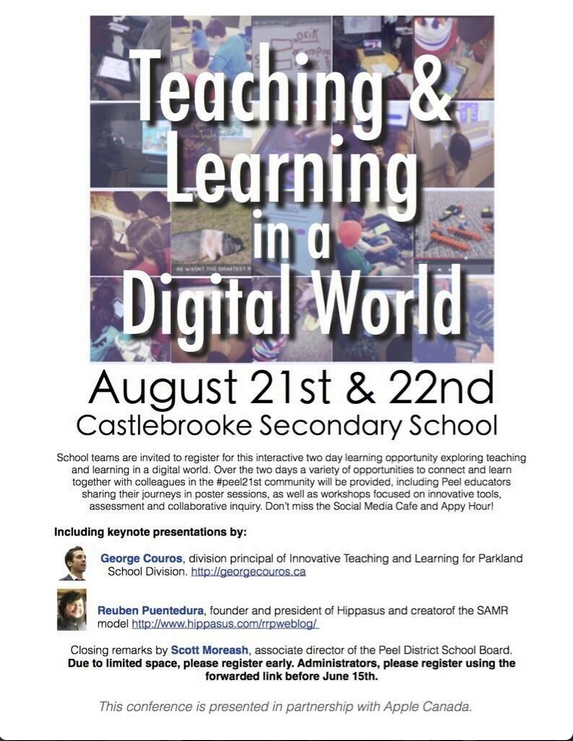
However, for myself and 600 other Peel educators, summer ended a bit early; as the first ever 'Teaching & Learning in a Digital World' conference was held for those who were looking to get a head start on #peel21st education. I had the opportunity to share my flipped classroom experience with an amazing amount of peers, and learn from them as well. However, I always find myself short on time in conversing & discussing with fellow educators about the flipped classroom and everything edtech. The questions, the comments, and stories of other teachers own experiences always rejuvenates me to continue sharing and offering any help I can. 

I found, and this is probably mainly due to the time of year, that the number one question on everyone's mind was "How do you start the semester in a flipped classroom?" The answer, unfortunately, is not so simple. It all depends on the depth you are taking with the flip, and what you hope to get out of it. There are a hundred different ways to flip your classroom, no singular right way, probably plenty of wrong ways, and lots of in-between. Each subject demands a different approach, each set of students have different requirements/needs, and each teacher their own personality.  Therefore, I can only really speak from my own experience and the approach I took of flipping my business courses, every day, for the entire semester. When you put that context on it, and step back for a second to think, you begin to realize you need to really lay a solid foundation. You also begin to realize that you are taking an entire student's school/classroom experience and throwing it out the window (and in a way saying that how they've been taught previously is not effective). Therefore, the first week of school, in my mind, is very important. So here's my approach:


(you'll notice the links below directing to many of the resources I talk about - check them out!)

Day 1 - Informing
As mentioned, you are taking all your students know regarding a classroom and flipping it on its head, throwing it out the window, or whatever else; and you are expecting them to buy in to this new methodology. Well guess what comes with change? Resistance! Therefore, I feel it is vitally important to be as transparent as possible with what I'm doing and really show them what a flipped classroom is. I show them great videos explaining the flipped classroom, both from a teacher's and student's perspective, inform them of my own objectives of the flip, indicate the benefits of the flip, share previous students comments, and lastly, run through what a typical class looks like. I also realize that I'm asking them to take pretty good notes while watching the videos, and therefore, teach them how to effectively watch the lecture videos (remember these are NOT LOLcats, or Fail videos, but videos containing important course information). Not only am I asking the students to buy in, but the parents have to as well. They are going to see their children come home  every night and instead of traditionally do homework, they will sit in front of a computer (or whatever else) and watch videos. Therefore, it is also vitally important to inform the parents in the same way, and send a letter home to do just that. (***Correction: Crystal Kirch is a MUST for #flipclass and source for my letter to parents -http://flippingwithkirch.blogspot.ca/.  Erin Klein is definitely a great source for #edtech and was mentioned incorrectly previously as flipclass source, probably because I was just reading her blog)

Day 2 - Connecting
Connecting with your students in a flipped class is probably no different then what you do now. The only difference is, that because you are flipping, you are probably using a variety of online tools to connect with your students and distribute your information. I use YouTube to share my videos, ANGEL (a LMS specifically designed for the Peel DSB) to convey course information, due dates, worksheets, links, etc., Twitter to post announcements & reminders, Wikispaces to collaborate & share, Blogger to blog, and so on. Therefore, I need to make sure that my students can connect to all these tools in order to effectively connect with them; and guess what, that takes time. Many students already have accounts on these platforms, and so you want to get them to 'follow' you so that they don't miss any announcements, etc. For those students who don't, this is where you can try to convince them of using such platforms, and the benefits they bring. As for the negatives, well that's why there is...

Day 3 - Citizen-ing (Digital Citizenship)
As you can see from the previous day's overview, there is plenty of 'connecting' and accessing of the Internet. The students already have quite the presence online, but what they don't necessarily have is the knowledge, respect, and appropriate attitude on how to conduct themselves online. Therefore, I believe it is very important to spend at least one whole day instructing them on what it means to be a digital citizen (a great overview is provided here by Jim Cash) Plus, now that you've instructed them on the flipped classroom, you can show them any number of videos on digital citizenship, and use the entire class to really 'do' and discuss. Since I come from a marketing background, I feel students connect really well to the idea that they are their own brands, and therefore illustrating the failures of many company brands when they have tweeted, texted, or promoted themselves inappropriately. Learning from failure is a great way to learn!

Day 4 - Dialogue & Discussing
As part of the flipped classroom, and one of the main reasons why I flip, is that it provides students with plenty of opportunity to summarize, ask questions, dialogue, and discuss course material. All of this boils down to the fact that I want my students to think critically. I begin every class with structured discussions for those who watched the video prior to class, so that self-, peer-, and teacher-assessment can take place. Therefore, if I expect them to effectively handle such a task, I need to make sure I teach them how to. I use the resource 'Groups at Work' because I find it offers plenty of activities for effective dialogues and discussions. Laying the foundation for effective discussions in the first week, will pay dividends down the road. 

Day 5 - Instructing
This is basically day one of the course that you may have traditionally experienced. As you can see, each of the previous day's lessons has not even touched on curriculum yet! In the traditional classroom this might be the point where you begin to freak out and say "How the hell am I going to cover the curriculum now that I've lost 4 days!" However, as a flipped teacher this is the point where you begin to relax and say "Now that I've spent 4 days teaching them the basics, and laying the groundwork, I can now ensure we effectively cover the course curriculum" (or something to that extent right?). With a flipped classroom, you have plenty of time to cover the course material. You can lengthen, shorten, combine, or do whatever to your videos (if that is what you are using to distribute information) and therefore ensure you cover the course material. You have time to cover necessary skills, that previously, may have been overlooked because you need to "just get through this lecture". Time becomes your friend as you can begin to manage it in a much more reasonable way, slowing down the delivery, and ensuring understanding. This is one of the best things about the flipped classrooms!


Friday, May 10, 2013

The Pushback... and the Push Forward

It's May. Nearing the end of the year. Staff and students alike are starting to sense that summer vacation coming on, and things are getting a little testy when it comes to completing work. This is my first experience with the Flipped Classroom at this point in the year, and I'm definitely beginning to see some difficulties in keeping my students focused and engaged with the philosophy.

The first sign of this came the other day, when several students openly, and honestly, told me that they weren't going to watch the videos anymore. For various reasons, they felt as though they didn't need to, or couldn't find the time. It was an honest expression of their feelings and I welcomed the input. It allowed me to consider how the flip is impacting my students; and how they view the 'new way of doing things'. What began as an individual comment-in-passing, led to a frank discussion with the entire class. Many shared their feelings on the flip, and what they wanted to change. Standing there listening to their comments, made me consider a number of things.
  1. Not all students will appreciate the flipped classroom. This reaffirms my thoughts at the beginning of the process, that most students have been hardwired into the traditional method of education, and it's difficult to get them out of that. Furthermore, just like the flip benefits some learners due to their learning style, it will also be resisted by other learning styles.
  2. You have to change things up, and keep them fresh. I begin each class the same way, and really focus on having the students discuss their learning from the previous nights video. I still believe this is a valuable start to the class, but also have come to realize, that it becomes tiresome for the students. I have to change things up more regularly, just like you would in any class, and keep things interesting (especially the start of each lesson).
  3. I've found the students have mixed reviews regarding the videos, and what they actually are. Some of my students, for the first time, have said they view them as homework - this is in stark contrast to my previous semester's class who did not. Realizing this, I need to really shorten the videos so that they don't become such a burden.
  4. It is a learning process for both teacher and students. Just like the students have had to adjust to the flipped classroom, I also need to adjust. I have to learn from them as much as they do from me. However, this is where the flip truly shows its value. Due to the freed time in class to really connect with your students and talk to them, you have plenty of opportunity to really gather their input. That in itself is well worth the process.
I still believe there are far too many benefits that have come as a result of the flip; and far too many to ignore in order to go back to the "same ol' way of doing things". The fact that the flip is a process, has allowed me to continuously reflect, solicit feedback, and make adjustments as necessary. I've heard many say it many times, flipping your classroom is not a 'tool' for your classroom, but a 'philosophy'. I wasn't sure I understood it until now. Understanding this will allow you to take such resistance in stride, and push you forward to continuously improve and ensure the learning is happening.