Showing posts with label Flipped Classroom. Show all posts

Wednesday, August 21, 2013

Starting Fresh

The stores are abuzz with "back-to-school" sales; the CNE is alive with glowing lights, carnival toys, and food poisoning; and every teacher is counting down the number of patio/cottage/camping days they have remaining. Yes, it's that time of year again.


Epic Burger at the CNE (Epic illness?)

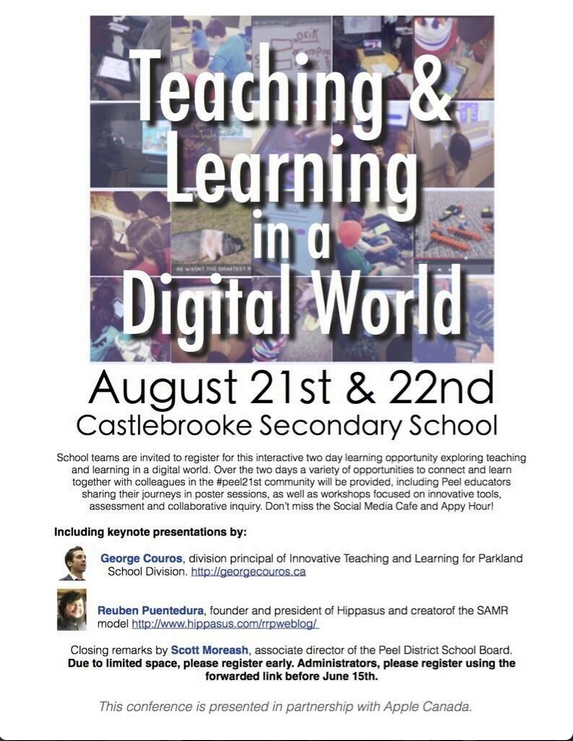
However, for myself and 600 other Peel educators, summer ended a bit early; as the first ever 'Teaching & Learning in a Digital World' conference was held for those who were looking to get a head start on #peel21st education. I had the opportunity to share my flipped classroom experience with an amazing amount of peers, and learn from them as well. However, I always find myself short on time in conversing & discussing with fellow educators about the flipped classroom and everything edtech. The questions, the comments, and stories of other teachers own experiences always rejuvenates me to continue sharing and offering any help I can. 
I found, and this is probably mainly due to the time of year, that the number one question on everyone's mind was "How do you start the semester in a flipped classroom?" The answer, unfortunately, is not so simple. It all depends on the depth you are taking with the flip, and what you hope to get out of it. There are a hundred different ways to flip your classroom, no singular right way, probably plenty of wrong ways, and lots of in-between. Each subject demands a different approach, each set of students have different requirements/needs, and each teacher their own personality.  Therefore, I can only really speak from my own experience and the approach I took of flipping my business courses, every day, for the entire semester. When you put that context on it, and step back for a second to think, you begin to realize you need to really lay a solid foundation. You also begin to realize that you are taking an entire student's school/classroom experience and throwing it out the window (and in a way saying that how they've been taught previously is not effective). Therefore, the first week of school, in my mind, is very important. So here's my approach:


(you'll notice the links below directing to many of the resources I talk about - check them out!)

Day 1 - Informing
As mentioned, you are taking all your students know regarding a classroom and flipping it on its head, throwing it out the window, or whatever else; and you are expecting them to buy in to this new methodology. Well guess what comes with change? Resistance! Therefore, I feel it is vitally important to be as transparent as possible with what I'm doing and really show them what a flipped classroom is. I show them great videos explaining the flipped classroom, both from a teacher's and student's perspective, inform them of my own objectives of the flip, indicate the benefits of the flip, share previous students comments, and lastly, run through what a typical class looks like. I also realize that I'm asking them to take pretty good notes while watching the videos, and therefore, teach them how to effectively watch the lecture videos (remember these are NOT LOLcats, or Fail videos, but videos containing important course information). Not only am I asking the students to buy in, but the parents have to as well. They are going to see their children come home  every night and instead of traditionally do homework, they will sit in front of a computer (or whatever else) and watch videos. Therefore, it is also vitally important to inform the parents in the same way, and send a letter home to do just that. (***Correction: Crystal Kirch is a MUST for #flipclass and source for my letter to parents -http://flippingwithkirch.blogspot.ca/.  Erin Klein is definitely a great source for #edtech and was mentioned incorrectly previously as flipclass source, probably because I was just reading her blog)

Day 2 - Connecting
Connecting with your students in a flipped class is probably no different then what you do now. The only difference is, that because you are flipping, you are probably using a variety of online tools to connect with your students and distribute your information. I use YouTube to share my videos, ANGEL (a LMS specifically designed for the Peel DSB) to convey course information, due dates, worksheets, links, etc., Twitter to post announcements & reminders, Wikispaces to collaborate & share, Blogger to blog, and so on. Therefore, I need to make sure that my students can connect to all these tools in order to effectively connect with them; and guess what, that takes time. Many students already have accounts on these platforms, and so you want to get them to 'follow' you so that they don't miss any announcements, etc. For those students who don't, this is where you can try to convince them of using such platforms, and the benefits they bring. As for the negatives, well that's why there is...

Day 3 - Citizen-ing (Digital Citizenship)
As you can see from the previous day's overview, there is plenty of 'connecting' and accessing of the Internet. The students already have quite the presence online, but what they don't necessarily have is the knowledge, respect, and appropriate attitude on how to conduct themselves online. Therefore, I believe it is very important to spend at least one whole day instructing them on what it means to be a digital citizen (a great overview is provided here by Jim Cash) Plus, now that you've instructed them on the flipped classroom, you can show them any number of videos on digital citizenship, and use the entire class to really 'do' and discuss. Since I come from a marketing background, I feel students connect really well to the idea that they are their own brands, and therefore illustrating the failures of many company brands when they have tweeted, texted, or promoted themselves inappropriately. Learning from failure is a great way to learn!

Day 4 - Dialogue & Discussing
As part of the flipped classroom, and one of the main reasons why I flip, is that it provides students with plenty of opportunity to summarize, ask questions, dialogue, and discuss course material. All of this boils down to the fact that I want my students to think critically. I begin every class with structured discussions for those who watched the video prior to class, so that self-, peer-, and teacher-assessment can take place. Therefore, if I expect them to effectively handle such a task, I need to make sure I teach them how to. I use the resource 'Groups at Work' because I find it offers plenty of activities for effective dialogues and discussions. Laying the foundation for effective discussions in the first week, will pay dividends down the road. 

Day 5 - Instructing
This is basically day one of the course that you may have traditionally experienced. As you can see, each of the previous day's lessons has not even touched on curriculum yet! In the traditional classroom this might be the point where you begin to freak out and say "How the hell am I going to cover the curriculum now that I've lost 4 days!" However, as a flipped teacher this is the point where you begin to relax and say "Now that I've spent 4 days teaching them the basics, and laying the groundwork, I can now ensure we effectively cover the course curriculum" (or something to that extent right?). With a flipped classroom, you have plenty of time to cover the course material. You can lengthen, shorten, combine, or do whatever to your videos (if that is what you are using to distribute information) and therefore ensure you cover the course material. You have time to cover necessary skills, that previously, may have been overlooked because you need to "just get through this lecture". Time becomes your friend as you can begin to manage it in a much more reasonable way, slowing down the delivery, and ensuring understanding. This is one of the best things about the flipped classrooms!


Friday, May 10, 2013

The Pushback... and the Push Forward

It's May. Nearing the end of the year. Staff and students alike are starting to sense that summer vacation coming on, and things are getting a little testy when it comes to completing work. This is my first experience with the Flipped Classroom at this point in the year, and I'm definitely beginning to see some difficulties in keeping my students focused and engaged with the philosophy.

The first sign of this came the other day, when several students openly, and honestly, told me that they weren't going to watch the videos anymore. For various reasons, they felt as though they didn't need to, or couldn't find the time. It was an honest expression of their feelings and I welcomed the input. It allowed me to consider how the flip is impacting my students; and how they view the 'new way of doing things'. What began as an individual comment-in-passing, led to a frank discussion with the entire class. Many shared their feelings on the flip, and what they wanted to change. Standing there listening to their comments, made me consider a number of things.
  1. Not all students will appreciate the flipped classroom. This reaffirms my thoughts at the beginning of the process, that most students have been hardwired into the traditional method of education, and it's difficult to get them out of that. Furthermore, just like the flip benefits some learners due to their learning style, it will also be resisted by other learning styles.
  2. You have to change things up, and keep them fresh. I begin each class the same way, and really focus on having the students discuss their learning from the previous nights video. I still believe this is a valuable start to the class, but also have come to realize, that it becomes tiresome for the students. I have to change things up more regularly, just like you would in any class, and keep things interesting (especially the start of each lesson).
  3. I've found the students have mixed reviews regarding the videos, and what they actually are. Some of my students, for the first time, have said they view them as homework - this is in stark contrast to my previous semester's class who did not. Realizing this, I need to really shorten the videos so that they don't become such a burden.
  4. It is a learning process for both teacher and students. Just like the students have had to adjust to the flipped classroom, I also need to adjust. I have to learn from them as much as they do from me. However, this is where the flip truly shows its value. Due to the freed time in class to really connect with your students and talk to them, you have plenty of opportunity to really gather their input. That in itself is well worth the process.
I still believe there are far too many benefits that have come as a result of the flip; and far too many to ignore in order to go back to the "same ol' way of doing things". The fact that the flip is a process, has allowed me to continuously reflect, solicit feedback, and make adjustments as necessary. I've heard many say it many times, flipping your classroom is not a 'tool' for your classroom, but a 'philosophy'. I wasn't sure I understood it until now. Understanding this will allow you to take such resistance in stride, and push you forward to continuously improve and ensure the learning is happening.

Wednesday, April 17, 2013

Think About It... You Have Time

When anyone ever asks me why I started flipping my classrooms, my answer is always the same - "I wanted to improve the quality of learning in the actual classroom". I don't mean to sound all 'high and mighty', but it is the truth. The traditional classroom model wasn't doing it for me; I needed to do something more. Hence, the flip.


The benefits of the flipped classroom have been covered, and covered, and covered, and covered, and... well you get the idea. Most discuss the engagement of students, the connection they have with their teachers, and the ability of teachers to assess students' learning more effectively. This is all well and good, and the data supports it; but one thing that is not discussed enough is the enhancement in critical thinking. This is the one observation that struck me the most 'post-flip'. It's not something I necessarily planned on, but upon reflection, I realize that the flip allowed me so much more time to do activities; and this gave me the opportunity (finally) to really focus on improving the thinking during those activities.


There's no singular way to improve critical thinking; and really this is no different from a traditional classroom. No matter what the classroom, critical thinking is still composed of analyzing, evaluating, reasoning, decision-making, and problem solving.


Therefore, having the students reflect on their work, and answer those 'why' and 'how' questions should be done in any classroom.  The difference is, you have much more time to really answer those questions; while still providing the students with enough time to engage in hands-on activities.

My class time now is not rushed; I have plenty of time at the end of the period to really debrief, and have the students think about what they did for the class. With the flip, the students are now provided with the opportunity to share what they have learned, to discuss, to challenge, and to provide reasoning for their actions; something that may have been rushed previously.

I also have the time now to begin every class with discussions between the students - NOT directed by me. They are able to engage and question each other, because they have that opportunity. Every class (well most) begins the same way whereby the students discuss the previous nights video through summary, their own discussion questions, and then a question I pose to them. We have learned how to properly discuss, and are working on this very important skill. The students are beginning to see how discussion of concepts matter; as compared to simply copying down lecture notes of these concepts during class.

So whether you're considering the flip because of better engagement, assessment, or in my case, improved critical thinking, either way, you have lots of time to figure it out.

Friday, April 5, 2013

The Times They are a Changin'

I found myself today in the presence of a few hundred educators discussing the concept of the 'flipped classroom'. The day was filled with engagement, questions, and lots of enthusiasm for beginning the practice of flipping classrooms - both at the elementary level and secondary level.

I had the opportunity to share my own thoughts, beliefs, concerns, practices, and experiences from my time (albeit limited) flipping my own classroom. Such an opportunity to actually meet face to face has not presented itself all too often; well come to think of it, never actually. The communication that I have had up until this point has been all online; whether I'm reading articles, tweeting, emailing, or reading other peoples' blogs, I am constantly online looking to improve my professional practice with the flipped classroom. Therefore, today was a nice change to really talk to people face to face, and provide, as well as receive, instant feedback and input. From this, I came away energized and enthusiastic, just like those who attended, to get back at flipping my classroom and adding further experiences to the conversation.

Which brings me here. Friday night. Writing on my blog. The first sign of #flipclass addiction. I realize this seems ridiculous, and really it is, but here's why. The conversation that's happening regarding #flipclass is really happening online. The rare opportunities that we have to get together and share our experiences, are just that - rare. And because of this, I know now, more than ever, the importance to adding to the conversation; whatever the day, time, or place, you can add to this conversation. So here's my thoughts.

Instead of sporadically writing and reflecting - I need to write more often.
Instead of reading a lot from others - I need to add to the conversation. And more often.
Instead of long blog entries - I need to provide shorter entries. Just like my videos, short and sweet, means more meaningful learning.

My thinking is that adding something to this conversation, is something we can all do; and I hope we all do, no matter what stage you are at in this process.

Therefore, from here on in, I'm going to reflect more. Share more. And write about experiences with the flipped model. I'll try to add #edtech 'stuff' in as much as possible, but it won't be the same focus. I'll be sharing about how I start my classes; how I teach my students to take notes; the debate between long or short videos; how to ensure technology, and thus video access; how to get parents on board; how using YouTube has helped my process; the responses I've received from my students; how I use a Twitter class page in conjunction; and really any other thought I have regarding the flipped classroom.

So if you're already following along (all one of you?), or if you're new to the flipped class method, or if you're already invested in it, I hope you find this useful. I hope, if anything, I am simply able to add to the conversation. Oh, and if you have anything you'd like me to share, then let me know. Drop me a note, a tweet, a message, and hopefully I can provide some insight. I can't provide expertise, only experience.

Thursday, March 7, 2013

One Semester Down...

Many more to go! That's the best way to describe the 'flipping' process. Like many of us like to say, "learning is a journey", the process of flipping your classroom is no different. There are the highs - students coming to your class the next day, all excited, laughing, and telling you that they enjoyed your video; the lows - students coming to your class the next day, confused, perturbed, and annoyed because the video you posted had its sound cut out half way through; and then everything in between. However, the one thing that I can say is that the process itself has been exciting.

As part of this exciting process, I, and a few other teachers, have been tasked with assessing this process; and to evaluate how effective the Flipped Classroom is for students. We have applied for resources ($) to help us on this journey and are approaching the date where we present our findings to others around the school board. However, whatever the data shows, and although I'm sure it will be positive, I don't think I need any data to tell me how this process has helped my own teaching practice, and here's why!

Physical Space - one thing I have discovered this year is how important the physical space of a classroom is! I know this seems silly, but when you have discussions, frequent technology use, group work, and a whole period worth of time of ACTIVE learning (75 minutes), you realize the physical space in a classroom is very important. Who knew round tables, bean bag chairs, and an open, airy environment would help so much?!

Student Technology Use - I've always realized that technology is important, I just have never placed as much importance on it in the classroom, as I have this year. When you are constantly using technology to create videos, activities and other resources for students, you begin to realize how important it is for students to also use it; and become comfortable with it. If a profession like teaching is bombarded with technology, just think what other professions will be like when our students begin their careers?

Support - flipping your classroom is not a practice for everyone. I, like many, are one of very few who are flipping their classrooms in their own schools; if there are any at all! I am lucky in that I have someone else to discuss the practice with on a daily basis, and in person; but for others, this is not the case. It is a new journey for many, and having others to discuss 'flipping' with is so vitally important. That's why I have to say that Twitter, yes Twitter, is probably your best support system. Featuring weekly #flipclass chats (Monday @ 8 pm EST), and hundreds of others who regularly tweet their thoughts and experiences on the Flipped Classroom, it has become my go-to for everything #flipclass.

So we will see what the data tells us, but either way, it has been well worth it.

Sunday, December 30, 2012

Busy Year of Flipping

Busy - the one word that really summarizes this past year in my classrooms. This was due to the significant shift that occurred in my teaching and learning. What started as a modest curiosity, quickly morphed into a full-on ideological transformation in how I run my classrooms. The idea of 'flipping' my classroom was something that seemed too good to pass up; it seemed like something that was too beneficial for my students not to at least try for them. And so I did, jumping into the deep end with only the 'twitterverse' as my support. It has been an enlightening experience, it has added an energy boost back into my teaching, and it has improved the excitement of my classroom. So, at this time of year, one full of resolutions, reflections, and aspirations, I thought it was an appropriate time to do the same, with a little 'flipclass' focus.

Resolution
"I will add the flipped model of teaching to all of my courses."
This really summarizes my thoughts and opinions on the teaching methodology. I went into this year using one of my courses as the lab; experimenting with the flipped model to really see how effective it could be. Based on the results I can't, with good conscious, not at least try to do the same with my other courses. The results in my 'lab' have been too positive - improved test scores, greater critical thinking, improved application of course concepts, and a greater dynamic to the class itself. Therefore, it only makes sense to implement the model into my other courses/classes and continue the 'experiment'.

Reflection
"I have made some mistakes, but all-in-all, this has been fun."
I was excited to try the 'flip', but didn't expect it to be so much fun (that dreaded F word!). I found myself enjoying both making the videos for my students, and the discussions we had in class about them. Now don't get me wrong, I still find it highly embarrassing listening to myself on the videos, but my students, seem to enjoy them. What started as a simple request "Sir, can you add a theme song?", began a trend of me continuously adding more and more creative elements to the videos. I still have a long way to go on that front, but it's been fun (there's that word again!) learning about all the different ways to make creative videos. And as for the classroom, well the amount of time now available for class discussions, connecting with my students, and really applicable activities, has made the classroom itself so much more enjoyable.

Aspiration
"My classroom will become an inviting, welcoming, and creative place."
The transformation of my classroom is an ongoing process, one that I don't think will ever stop. The biggest challenge has been to modify my students 'way-of-thinking' from the traditional model, to the flipped model. This has been difficult at times, and I have quickly come to realize that my students have had 11 years of 'programming' completed on them; and so of course this will be difficult to change. Altering their programs will only come as a result of significant changes to the process AND the environment. Therefore, my whole classroom environment has to change - a layout that will allow for greater discussions and collaboration (it's all about circular tables!). I plan on continuously changing the classroom, and not just my teaching, to allow for greater learning, collaboration, and most importantly creativity.

So with one semester down, and many, many more to go, the future looks interesting, exciting, and yes fun!

Thursday, September 20, 2012

Flipped FAQ's

Teaching teachers about technology - sounds like a bit of a tongue twister. It felt a little bit like one last Friday when myself, and a few other peers 'attempted' to teach the staff at my school about various technology practices. Over the course of an hour and a half (all the time the school board allowed for technology PD - sad, I know) teachers engaged in a series of workshops related to technology. Their options included the use of Twitter in the classroom, using an online class system called Angel, blogs, wikis, and of course the flipped classroom.

The response to all the workshops was great, and I think a few eyes and minds were opened. The flipped classroom session was no different. Staff really seemed to respond positively to the idea, and even the most trepid amongst the participants seemed to at least begin to think about the possibilities. After the very brief 30 minute session was complete, there were however a number of questions that were left unanswered. Therefore, below I have at least attempted to answer all the questions posed by participants from my own perspective. This does not mean that these responses are correct in any way, just my own thoughts and ideas.

1.What do you do if the students don't watch the videos?
Generally, the response from students has been good so far. Students who I have taught in the past, and who have caused me some grief with their lack of participation and learning, are responding very positively to watching the videos. They are coming to me in advance and informing me that they may not be able to watch the video that night. This would have never happened previously; they would have simply came to class the next day and told me they didn't do their homework. Thus they are demonstrating not only commitment, but also careful planning and time management. However, in dealing with the students who do not watch the videos, I make sure to allow for those students to watch the video at the very beginning of class, while other students who have watched the video engage in group discussions. I entered into this flipped-class model with the idea that I'm not going to fight a losing battle, and will simply try to accommodate. This does not mean I am not keeping track of those who continuously come to class without watching the video, and when I feel like it has gone on for too long, I will make adjustments then.

2. How will the flip-class help language learners?
I am not an ESL nor language teacher, so my knowledge of teaching languages is limited (limited equals none in this case!). However, I will say, that it is my belief that students learn best when they are using multiple senses. Whether you use videos, or any other resource in your flipped classroom, just make sure they are using multiple senses. I think videos really can help language learners because they are able to slow them down, replay, re-watch, take careful notes, and listen to the words as well as read them on the screen. I have to believe this really helps language learners?!

3. What does the class look like now? What do lessons look like?
My class as it stands is still very similar to how it looked previously. There may be a bit more 'organized chaos' at the beginning of class, but I still have students seated in groups and working independently at times. I am not yet at the mastery level of flipping, and so my classroom does not yet look like a drop-in centre; however, I am loosening the reins a bit and beginning to allow organization to fall to the students.
Lessons are still very similar to the traditional class. They are still broken down into 3 parts, however, the 'action' part, or 'do' part, now takes up the majority of class time. I think this is important, and is the reason why I flipped. I still however, want my students to think about, and discuss, the previous night's video, and so that now comprises the beginning of my lesson. As well, I feel it's still important to debrief the 'action' part and ensure the students truly understand the lesson. This part however, I am sure will become more difficult as the students begin to work at their own pace and time-frame. We'll see how it looks then?

4. How can you flip your class easily?
I don't know if there is any 'easy' way to flip? I guess you could simply assign textbook reading material instead of videos or other sources of information; but I don't believe students would really buy into this type of flip. I think video still offers a lot of benefits, and thus makes flipping hard work. However, I believe there are two ways you could flip that might be easier than making daily screen-cast videos:
a) Video tape your lectures for one whole semester. This way you will have all your lessons on video that you can use the next semester when you flip. It wouldn't really add any extra work, and you could still use video as your 'flipping' material.
b) Flip your class once/twice a week, and gradually increase it for each subsequent semester. Therefore over the course of a year or two, you would have all of your videos created for your 'flip-out'

5. How do you ensure students watch the video and really learn the material?
There is no difference in ensuring students understand the material in the flip-class as compared to a traditional classroom. I use regular quizzes to make sure, and hold discussions to assess. Eventually I would like to set up online quizzes to assess the students immediately after watching the video, and feel this would be a fantastic way to keep track of progress (think Khan Academy). Until then, it's really business as usual.

6. What about access to technology for students?
This is something that I don't have any issues with in my classes. However, I did make sure to send a letter home to their parents to ask them about their access to technology. This will help me ensure all students can watch the videos posted on Youtube. As well, the amount of time students have during their lunch, the time they have before and after school, and the prevalence of mobile technology, there are definitely ways to ensure students have access to watch the videos.

7. What tips do you have for video content?
I think it's important to have lots of visuals to accompany text. Therefore, I also believe text is important so students are able to read if they are not necessarily auditory learners. I try to include a visual to accompany most of my text, and use PowerPoint slides to do this. Eventually, animation, highlighting, and other visual aids will be included so that the information is emphasized. The other part that I feel is important is to make the videos more than just the curriculum material. The students in my class have responded positively when I sing a theme song to begin each of my videos, when I tell personal stories to help emphasize material, and when I joke around on the video, just like I would in class. Making the videos your own and ensuring they convey your personality I think is very important; because I think some students may rather still have you as a teacher at the front of the class teaching like this. Which brings me to...

8. How can a video be more interesting than in-person lectures?
I don't know if there is any way to be more interesting in a video as compared to person. I think you can be close, but I don't know if I ever will be. The one thing I have found though, is that as I have made more and more videos, I have become more and more comfortable, and my personality is definitely showing itself more in the videos. I think that as time goes on, and my video production skills increase, the videos will become more and more interesting. Accompany this with still interesting classes, and I believe students won't really miss a thing (cue Aerosmith).

Sunday, September 9, 2012

It's Been One Week...

... since you looked at me." Sorry was a little distracted there with the Barenaked Ladies song in my head. This post is about one week, but not at all what the BNL were singing about. It has been one week since I started flipping my marketing classes, and the results so far? Well a little inconclusive. However, I will say, things look promising.

I started this semester with the idea of 'training' my students. I figured that if they have experienced 10+ years of school one way, than the first couple days in the flipped classroom would be a bit of an adjustment. I proceeded this year with the usual introductions and course outlines, however, instead of taking too much time on that, I used the majority of the first class introducing the students to the flipped class model. I presented to them an informational presentation on the flipped model in the usual way - me standing at the front of the class, and presenting the information to them like a "sage on the stage". I asked them what they thought of learning that way, and received the usual shy responses; "It's okay", "I don't mind", and "We're used to it" were the majority of responses. These responses indicated that my students were fine with the usual model, however, there wasn't any indication that they were enthused by it.
After presenting in the usual sort of way, I then explained that we would run through the new way of doing things in our class. I handed out note taking templates, and explained to them how to take notes while watching videos - key points, details, summary, and then a question that can be used for discussion. I then loaded my introductory video of "How to watch the lecture videos" which explained to them the STORM concept of watching videos (STORM is also our school mascot). You can take a look at the video here. I tried to set the theme, asking them to pretend that school has just ended and they are all sitting at home watching the video. I played the video and walked out of class to listen just outside the door (listening to yourself on video is highly embarrassing!). The students giggled at first, but surprisingly every single one took notes on the video! I came back into class, and reset the theme explaining that they have now all started the next school day, all have come to class and now we would begin the next day's lesson. At this point I explained how we would begin every class.
I arranged the class into 3 groups - Know, Wonder, & Learn. I explained to the students that they would decided which group to join based on their video viewing experience. The 'Know' group would consist of those students who watched the video, felt confident with the material, and completed their notes. In this group, these students would share their summaries, ask each other their discussion questions, participate in a discussion based on those questions, and then answer a question I posed to the whole group. The 'Wonder' group would be those students who watched the video, but did not feel confident in the material. I explained to them that I would be a part of this group, and would be there to answer any questions they might have regarding the material. We would therefore work through their questions to come to an understanding of the concept. The 'Learn' group would therefore be those students who did not watch the video prior to class and therefore needed to. I explained to these students that I was okay with them not watching the video once in a while, but if it became habit, then we would need to have a 'frank' discussion. The whole class seemed to buy into this method of beginning class and seemed to like the idea that they had options.
Once the students were 'trained' on video viewing procedures and the routine to start the class, I then explained that the rest of the period would be all about application. This would be where they would be challenged with a task to complete which had them apply their knowledge of the concept seen on the video. They seemed to also respond positively to this as they liked the idea that class was all about 'doing' now, and not just sitting there listening. I also explained that I would be able to help them much more during class (a real benefit of the model) and act as a tutor during the application if any of them needed it. I then ended the class by providing them the link to watch that night's video.

This procedure was something that I found in my research on others who are 'flipping' their classes. I liked the idea because the routine allows the students to basically run the beginning of class. It also allows me to assess the students learning and keep track of those students who continually struggle with their understanding.

The next day was somewhat positive. Unfortunately the link did not work for one of my classes, and half of the other; however, 99% of my students did try to access the video to watch it. From that standpoint it was very positive. That kind of response is something that I hope continues!

Due to the shortened week that's all the reflection I have. This week will consist of 4 videos that the students will be required to watch. Well see how it goes. Stay tuned!

Friday, August 31, 2012

Summer's Over Already?

Well summer is already over. It seems to always fly by, and I always seem to make the same comment - "it goes by too quick!". I try to decompress and disconnect during my summers; leave the school work, thoughts and ideas behind, and try to just enjoy the sunny, summer days. This year was no exception, and thus the reason why it's been a little while since my last post. However, I will say this, I found myself thinking a lot more of this upcoming school year than in year's past. The reason - it all has to do with 'flipping'.

I wrote a post not too long ago about the flipped classroom model of teaching. Over the last several months I have been researching extensively and putting together ideas for bringing this model to my classroom. A few colleagues and I have decided to jump right into this model, the deep end of course, and use this method of teaching this September. We have administration support, resources and $, and have set up the technology necessary for implementing the flip. I've planned out the videos, the activities that will be used in class, and the process to start the year. It requires quite a bit of planning and prepping and have come to recognize that as much as I don't want to think of school at all until September, if I really want to implement this model I had to get started a little earlier than usual. Surprisingly, I've been okay with this and have become a bit excited to get things going!

The very beginning of this year will require a lot of 'training' for my students to acclimatize them to the process. I plan on taking the first couple days just going through the routine and ensuring that they understand the process. The first day is usually a 'get-to-know-each-other' day anyway, so I figured I will still do this, but focus a bit more on 'get-to-know-the-flipped-classroom' instead. I've put together information for the students and expectations for the class and how to effectively watch the videos. For parents, I've also put together a letter (huge thanks to Crystal Kirsch!) and an information video so that they are completely aware of the situation. I can just imagine the first couple weeks when my students go home every night and watch videos instead of doing homework or other work! I figure laying the groundwork now will pay dividends later on.

The videos have been a bit interesting. It's always so foreign to hear your own voice, and a bit embarrassing talking to a computer screen. I've become a lot more comfortable in creating them however, and recognize the better you make the visuals, the better AND easier creating videos become. I've tried to keep them all between 5-15 minutes and hopefully the students appreciate this.

The last part of this preparation has been the in-class activities - something I've found through researching and online discussions, is often overlooked. I have found too many people focus the majority of their efforts on just creating the videos; unfortunately, this is the less important component of the flipped class model. Therefore, I've really tried to ensure that I focus on the types of activities my students will be engaging in class, after they have watched the concept videos. This I've found to be a challenging part of the preparation, as getting away from creating activities that last 30 minutes, and trying to create activities that last 65-70 minutes is difficult to say the least. 

Overall, I think I'm ready for the challenge. I guess this post is really about what I've experiences so far, and what I'm hoping for to start the school year. I don't expect it to be a seamless transition as this is a new way of learning not only for the students, but myself as well. I plan on continuously updating this blog (more frequently I promise) not only with useful tech tools that can be used in the classroom, but also my experience with flipping my classroom. I expect many of the posts will be me venting my frustration, but I hope to share some positive experiences as well. I think the key going into this whole thing is that this is not a one-semester experiment, but a continuous transition that will take several attempts before I see quality returns. Here's to a successful school year, and fingers crossed!

Friday, May 18, 2012

Online Classroom Flip-Out!

As has been discussed previously, online or virtual classrooms, are excellent digital tools that allows you to do many things with your students. Maybe one of the best uses could be using it to ‘flip your classroom’. Getting into a discussion on the merits of such a teaching philosophy is a blog post in itself, so I will avoid such a debate. Instead this post will simply be about providing you with the details of how to do it using your online classroom.
However, before we begin, a brief overview of flipping the classroom is needed. Simply put, flipping the classroom, is based on the idea of having students learn a new concept out of the classroom, so that when students return to class the next day, that knowledge can be applied and greater critical thinking can take place. This attainment of knowledge can come from watching online videos, digital presentations, reading their textbook , news sources, or wherever the information is. The implications of this practice means that rather than spending 90% of class time learning a concept and using the remaining 10% applying it, ‘flipping the classroom’ allows the teacher to allot more time on ensuring students understanding and providing greater critical discussions around the topic.
I would hazard to guess that most teachers want to achieve such a result. Imagine walking into class everyday knowing that your students have learned the concept on their own, and are ready to engage in such activities? This is the Utopian model of teaching! However, it’s not easy; and in most cases it means a bit more ‘up-front’ work for teachers.  It means teachers will need to organize, and in some cases, prepare a variety of digital resources for your students.
Step 1: Whether it’s a Prezi, PowerPoint, YouTube video, website, blog, or whatever it may be, these resources will be the required material that students access in order to learn new concepts. Therefore, lots of online researching is required and teachers need to accumulate a tremendous amount of digital resources.
Step 2: The next part is getting your students to buy into the concept. This is also easier said than done. However, the fact that you are using a digital platform to present information, students will more readily accept such learning. Much of their time is spent online anyway, and in many cases students would prefer this format. However, not every student will ‘buy into’ your model and this is where formative assessment plays a large role.
Step 3: One of the tools many virtual classrooms provides you with is the ‘assessment’ or ‘survey’ function. These functions allow you to create a quiz, test, or exam using questions you determine and input into the virtual classroom. They allow you to create any question type from multiple choice, to short answer, and therefore you can create a quick 10 question type quiz based on a resource you have asked your students to look at online. This follow-up and formative assessment will ensure your students are doing the required readings, video watching, or whichever learning you decide.
So what if your virtual/online classroom doesn’t have this tool. Well you can revert back to pen and paper and have a daily quiz when your students return to class the next day. Either way, you are ensuring your students are learning the concepts and following-up with them if they are not.
Online classrooms provide you with plenty of opportunities to engage your students. Using these tools to 'flip your classroom' could be what your students are asking for!