
Friday, January 22, 2016

Thursday, January 21, 2016
?
Why do we do the things we do...
Why do we set up our classrooms in rows?
Why do we design schools the way we do?
Why are classrooms closed off?
Why do we set up our desks at the front of the room?
Why do we have desks?
Why do we lecture?
Why do we have computer labs?
Why do we make technology an event?
Why do we assign tests, quizzes, and exams?
Why do we provide homework?
Why do we teach the same lessons as last year; as 5 years ago; as 10?
Why do we plan our lessons prior to knowing our students?
Why do we have school bells?
Why do we have audio announcements?
Why do we have 'community centres' separate from school?
Why do we start school before 10 am?
Why do we start the school year in September?
Why do we have exams after a winter break?
Why do we organize departments by subject specialties?
Why do we "prepare students for university"?
Why do we have grade levels based on age?
Why do we have lesson periods & semesters?
Why do we have subject specific courses?
Why do we run professional development the way we do?
Why do we teach in the same school for so long?
Why do we renumerate based on degree & length of teaching experience?
Why do we all not have to earn spec. ed. qualifications?
Why?
If we don't ask questions, how will we move forward?
Why do we set up our classrooms in rows?
Why do we design schools the way we do?
Why are classrooms closed off?
Why do we set up our desks at the front of the room?
Why do we have desks?
Why do we lecture?
Why do we have computer labs?
Why do we make technology an event?
Why do we assign tests, quizzes, and exams?
Why do we provide homework?
Why do we teach the same lessons as last year; as 5 years ago; as 10?
Why do we plan our lessons prior to knowing our students?
Why do we have school bells?
Why do we have audio announcements?
Why do we have 'community centres' separate from school?
Why do we start school before 10 am?
Why do we start the school year in September?
Why do we have exams after a winter break?
Why do we organize departments by subject specialties?
Why do we "prepare students for university"?
Why do we have grade levels based on age?
Why do we have lesson periods & semesters?
Why do we have subject specific courses?
Why do we run professional development the way we do?
Why do we teach in the same school for so long?
Why do we renumerate based on degree & length of teaching experience?
Why do we all not have to earn spec. ed. qualifications?
Why?
If we don't ask questions, how will we move forward?
Wednesday, January 20, 2016
Zone of Proximal Influence
I had the pleasure a few years ago of listening to a keynote by John Seely Brown. He shared insight into the world that he has occupied for so long - innovation. From his years at Xerox PARC to the Institute for Research on Learning, he provided great stories and details from his experiences. However, one thing more than any stuck with me; and to this day, I find myself repeating it to anyone I think could benefit from listening to...


I say this often to students, and have thought about this quote all this time in the context of the classroom. It has become part of my 'mantra' I guess when it comes to teaching. However, it recently struck me, what are we doing ourselves as educators?
Many of us frequently connect in virtual environments where we can share resources, stories, and insights into our 'worlds'. For the most part we've all been able to connect with peers in our buildings, families of schools, or region in real life as well on a somewhat regular basis. However, how many of us are lucky enough to have daily social interactions that push our learning forward?
I have benefitted from working daily with others who have shared my interests, and passion. Being able to plan together, bounce ideas off one another, and take risks has been an incredible learning experience. I wonder some days where I would be in my own learning if I didn't have such a 'zone of proximal influence' (copyright all rights reserved trademark keepsies no takebacks).
I don't think that is the kind of social learning that JSB was talking about, but imagine if everyone had this opportunity? What would the world be like?
Tuesday, January 19, 2016
Is the Staff Room Closed?
It's always interesting to walk into a school you are unfamiliar with. There are instant impressions made about the culture of the school. Like many cultural centres, there are many artifacts that tell us how to behave?; What is valued?; How people work, act, and use the space? All of these 'things' provide great insight into the teaching and learning in the school.

I've noticed none may be more telling than the staff room. I find as soon as I enter this secret world I am instantly attuned to the collaborative culture of the school. There are those rooms where you are welcomed, those where you are the invisible person, those where you want to join the party, and those where there the only party happened way back in 1957. It's always a surprise.
Up until today I have felt like staff rooms are for the most part 'closed'; a thing of the past, an ancient relic of systems, and structures past. I think these are spaces that could better be used, modified or overhauled for better purposes. Maybe another learning space for students or teachers?
However, I walked into a staffroom today at lunch and found myself wanting to be part of the party. A great number of staff were together, eating lunch, sharing stories, and breaking bread together. I know this could be a one off, but I was actually warned about this prior to going in there; that this happens daily. I was instantly struck by the culture that existed and wondered how did they get here?
I don't have an answer to this, and I am sure I could have simply posed the question to the group. I just wonder, what did they do to 'open' the staffroom again?

I've noticed none may be more telling than the staff room. I find as soon as I enter this secret world I am instantly attuned to the collaborative culture of the school. There are those rooms where you are welcomed, those where you are the invisible person, those where you want to join the party, and those where there the only party happened way back in 1957. It's always a surprise.
Up until today I have felt like staff rooms are for the most part 'closed'; a thing of the past, an ancient relic of systems, and structures past. I think these are spaces that could better be used, modified or overhauled for better purposes. Maybe another learning space for students or teachers?
However, I walked into a staffroom today at lunch and found myself wanting to be part of the party. A great number of staff were together, eating lunch, sharing stories, and breaking bread together. I know this could be a one off, but I was actually warned about this prior to going in there; that this happens daily. I was instantly struck by the culture that existed and wondered how did they get here?
I don't have an answer to this, and I am sure I could have simply posed the question to the group. I just wonder, what did they do to 'open' the staffroom again?
Tuesday, December 15, 2015
A Few of My Favourite Things
"Here's the next instalment of #Peel21st Blog Hop. This round we thought it would be great to share some of our favourite apps, tools, websites, books, blogs, and just about anything & everything else! Also, be sure to take a look at the blogs posted at the bottom, and hop from one to another to see some other best moments."

So it's always a great time of the year, kids are counting down the days until holidays, teachers are switching to sugar-only diets, and schools are abuzz due to the previous two things. It's also a great time to share, and so I thought I would. It's tough to choose favourites, but a blog hop with a title "Some of my Somewhat Favourite, well Almost Favourite, ok, Things I Really Like Things" just wasn't as nice sounding. So without further adieu, here they are...
Be sure to check out the other #Peel21st bloggers and their best moments!
Tuesday, November 17, 2015
Best Moment...
"This is the first #Peel21st Blog Hop of the year. After a bit of an irregular start to the school year, a few of us thought sharing our best moments thus far would be a great way to reconnect. Take a look at the blogs posted at the bottom, and hop from one to another to see some other best moments."

I was going to write about my best moment so far this year, and although this is true, it also has been my best moment since beginning in my role as a resource teacher. Since 'leaving' the classroom over a year ago, I've had few opportunities to teach in the classroom with students. This year however has been much different.
I've been able to co-teach several lessons with some teachers at a few of the schools I support. It's provided me the opportunity to engage with kids again, and placed me back in one of my favourite places in the world - the classroom. I don't like to get 'corny' or whatever you want to call it, but I've really come to realize how much I love the classroom; and how much I've missed it. It's only when you step outside of that for an extended period of time, do you understand what you have left.
These opportunities have also provided great opportunities to learn alongside other teachers, and observe their practices as well. You begin to see strategies, dynamics, techniques, etc. that you can only learn by collaborating together. The interplay between two teachers in a classroom is also so rewarding, and really makes me wish that was more common place (at the secondary level at least).
Students have also been awesome in allowing a stranger, such as myself, come into their community and work with them in learning various technology tools. They have really shown how much they want to learn various tools to support their learning, and crave the opportunity to explore these tools. There was a moment in one of the classes where we were basically holding a 'matchmaker' event - students throwing out ideas they want to do to complete projects & products for their courses, and I was throwing back ideas of tools they could use to complete such tasks. It was awesome to see their eyes light up, and brains explode somewhat, when they looked at the app/tool and what it could do; and made me realize that students crave creative expression, and are always looking for new ways to convey this. They also were able to show me tools & apps that I haven't heard of before, and put themselves in the role of the teacher to do so. That's not so easy to do, but they have a certain knack for it when it comes to showing technology, and I was wise to listen.
We never really get to step outside our own selves, and look back to see what we have done; or how we are progressing in our own practice. But this year has been just that, and I've really been able to reflect - I love being in the classroom; I love working alongside talented individuals; and most of all, I love learning alongside students.
What has been your best moment?
Be sure to check out the other #Peel21st bloggers and their best moments!
Wednesday, October 21, 2015
Back to the Future... of Education
In case you missed it today marks the day in Back to the Future II in which Marty & Doc jump in the Delorean and travel to in the future - October 21, 2015. I was 8 when that movie came out, but I still remember the hover board, and how I couldn't wait until I had my own in 2015. Well, today is today, and I still don't have a hoverboard, the Cubs haven't won the World Series, and there were only 4 Jaws movies (3 too many I know). However, as far off as that movie may have been with its predictions, the one thing it did do was give people a fascination with what the future may look like.

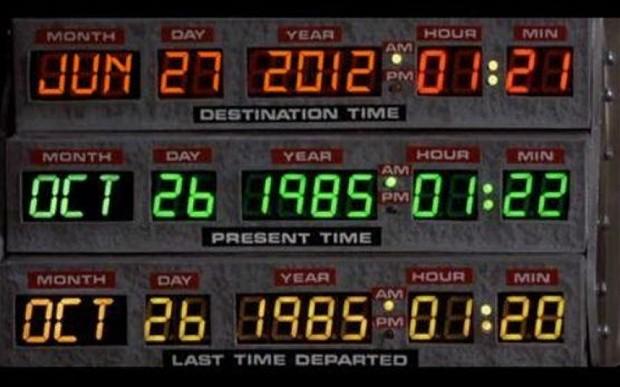
When it comes to predicting the future, it's not so much what you think will happen, but what you WANT to happen. There are a lot of things I hope may come true for the world, but that is just way too hard! Therefore, I thought I'd write a screenplay for the next installment of the Back to the Future franchise titled 'Back to the Future School'.
1. Technology IS Ubiquitous
- Yes in the future technology will not be treated as a side, to the regular classroom instruction. Using an app, web tool, or hardware device will not be treated as an event. Coding will be as ingrained in the curriculum as literacy or numeracy, and our debate over 1:1 vs. non 1:1 classes will be a thing of the past.
2. The Classroom Looks A Lot Like Your Living Room
- We will finally realize there is a strong connection between learning environment and learning. That if we want to truly differentiate our instruction, we also need to provide areas within the classroom that allow for this differentiation. Couches, chairs, individual seating, and group collaboration areas will all be the norm.
- Students will drive their own learning; popping into the class that they need to for that day & time. Want to work your way through the science curriculum today? Go for it. Want to solely focus on geography and history today, well that can be done. Don't hear a bell? Well that's because there aren't any. This may apply more to the secondary folk, but still could be applied to all grade levels.
- I know it's a terrible acronym but the point is we will place as much emphasis on all disciplines as we currently do with STEM. In order to be successful, students will draw on knowledge & experience from a variety of curriculum areas, and connect the dots. This also lends itself nicely to doing away with single subject classes, and offering courses that bring multiple curriculums together. Students will learn about the 'Physical World' a class that looks at Geography, Physics, Biology, and Math in one 'class'.
5. Just Do It
- Studying will take on a whole new meaning in the future. Students won't be cramming for a tests; they'll be studying on their own, when they need to, in order to actually demonstrate their learning by DOING. Single, one-off assessment pieces will be a thing of the past. Do I want to know what lil' Jimmy knows? Absolutely. But I want lil' Jimmy to show me through his demonstration, his ongoing learning process, and his ability to perform what he has chosen to learn about.
Will all of these things actually happen? Probably not. Some will be achieved, others won't be, and some we'll blow right past and offer solutions and examples I can't even fathom right now. Back to the Future didn't nail every prediction, but it didn't have to. It simply offered ideas, and inspired people to take steps toward making them a reality.
Subscribe to:
Posts (Atom)